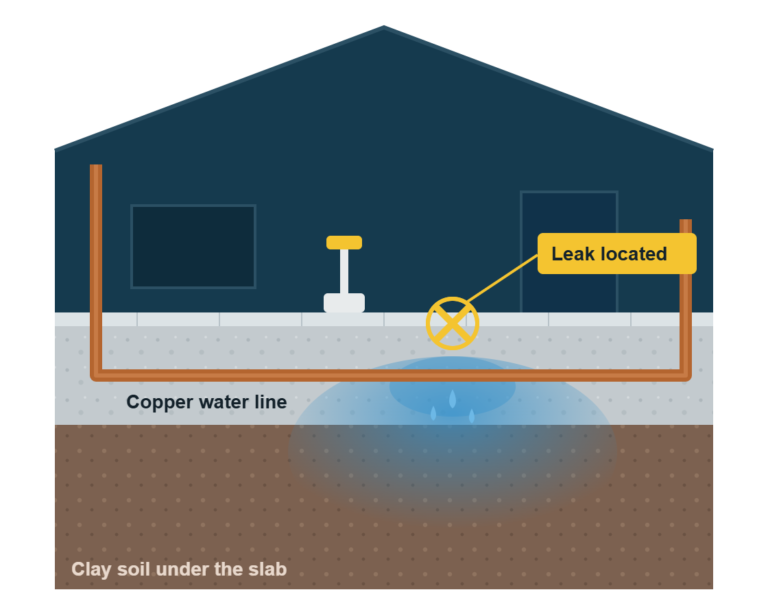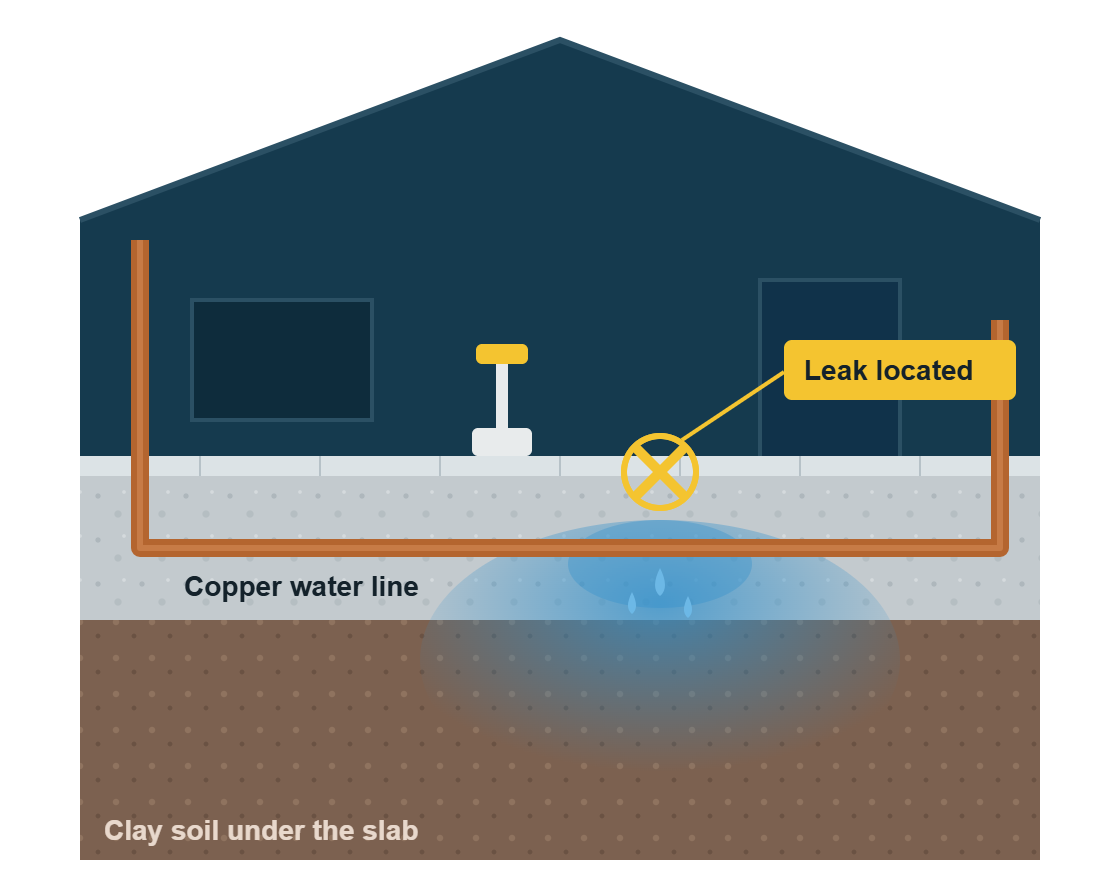
What Causes a Slab Leak? 7 Reasons Pipes Fail Under Concrete
When homeowners learn they have a slab leak, the next question is almost always the same: “Why did this happen?”
It’s a reasonable question. Nothing hit the pipe. Nobody dropped anything. It’s buried under concrete where nothing can touch it. And yet, one day, water starts escaping.
The truth is that slab leaks usually aren’t caused by one dramatic event. They’re the result of slow, invisible forces working on your pipes for years. This guide explains the seven most common causes, where even plumbers disagree, and which causes you can actually do something about.
The Short Answer
Most slab leaks are caused by a combination of:
Usually it isn’t just one. A pipe that’s been rubbing for 20 years, under high pressure, finally gives way at its weakest point.
1. Abrasion: Pipes Rubbing Against Concrete
Water pipes aren’t perfectly still. Every time hot water runs through them, they warm up and expand slightly. When they cool, they contract. This happens many times a day, every day, for years.
When a pipe is in contact with concrete, gravel, or rebar under your slab, that tiny back-and-forth movement acts like very slow sandpaper. Over time, it can wear a thin spot in the pipe wall, and eventually a pinhole.
Why hot lines are more affected: Hot water lines go through bigger temperature swings than cold lines, so they move more. That’s one reason a warm spot on the floor, from a hot water slab leak, is such a common first sign.
2. Corrosion: From the Outside, the Inside, or Both
Copper is durable, but it isn’t immune to corrosion.
From the outside: Pipes buried in soil or in contact with concrete can corrode where their outer surface meets moisture and minerals in the ground.
From the inside: Some plumbers believe the chemistry of the water itself, its minerals or acidity, slowly wears copper from within.
Where plumbers disagree
This is worth being honest about: not every plumber agrees on how much water chemistry causes slab leaks. Some point to water quality as a major factor. Others argue that pipes rarely fail from the inside out, and that movement and abrasion against concrete are the real culprits.
Our take: the specific cause of a single pinhole is often hard to pin down, and it’s usually a combination. What matters more for you is what the condition of the rest of your pipe looks like, because that decides whether a spot repair, a reroute, or a repipe makes sense.
3. High Water Pressure and Pressure Spikes
Your plumbing is designed to handle a certain amount of pressure. When pressure runs too high, for too long, it puts constant strain on every joint, fitting, and weak spot in the system, including the ones under your slab.
Sudden pressure spikes add to the problem. That loud bang you sometimes hear when a faucet or appliance valve shuts off quickly (called water hammer) sends a shock through the pipes.
What’s normal? Recommendations vary a little, but many plumbers suggest keeping household water pressure roughly in the 50–80 psi range, and plumbing codes generally call for a pressure regulator when incoming pressure exceeds 80 psi.
How to check yours: A simple pressure gauge on an outdoor hose bib tells you in seconds. Our how to find a slab leak guide explains how.
4. Thermal Expansion From Your Water Heater
When water heats up, it expands. In a tank water heater, that extra volume has to go somewhere. In many homes, a device on the incoming water line (like a pressure regulator or check valve) keeps that expanded water from flowing back out to the street. That creates a closed system, and the pressure builds up inside your pipes instead.
This is why many water heaters now need an expansion tank, a small tank mounted near the water heater that gives the expanding water a place to go. Without one, or with one that has failed, every heating cycle can add extra pressure to your plumbing.
Quick check: Look near your water heater. Is there a small tank, often shaped like a little propane tank, connected to the plumbing? If you’re not sure whether it’s working, ask your plumber to check it.
5. Installation Problems From When the House Was Built
Some slab leaks trace back to the day the slab was poured:
None of these show up right away. They can take many years to turn into a leak, which is why a builder’s mistake might not be discovered until long after the home was sold.
6. Ground and Foundation Movement
Soil under a home isn’t perfectly stable forever. It can settle, shift with moisture changes, or move slightly over time. When it does, the slab and the pipes beneath it can be put under stress, especially at joints and bends.
This is usually a slow, contributing factor rather than a sudden cause, and its impact varies a lot from home to home.
7. Time: The Multiplier
Every cause above gets worse with age. A pipe that’s been expanding and contracting for 10 years has done a fraction of the rubbing of a pipe that’s been at it for 30.
That’s why the age of your plumbing matters so much:
Older homes
30+ years
More likely to have repeat leaks, because the same forces have been working on every line under the slab. See our Paloma Del Sol page.
Newer homes
May have different pipes entirely
PEX became part of California’s statewide plumbing code in 2009, and PEX doesn’t corrode the way copper does. Its weak points are more often fittings and connections. See Wolf Creek.
Which Causes Can You Actually Control?
You can’t change how your home was built or how old it is. But some causes are absolutely within your control:
Within your control
Mostly out of your control
The two easiest wins: checking your water pressure and your water heater’s expansion tank. Both take minutes and can take real stress off your pipes. For more habits, see how to prevent slab leaks.
Technician Story
“We recently worked on a home where the homeowner had noticed an unexplained increase in their water bill, but there were no obvious signs of a leak inside the house. After locating the leak under the slab, we found that the copper pipe had been rubbing against the surrounding material over time. The repeated movement had worn through the pipe and created a small pinhole leak. It was a good example of how a pipe can fail gradually after years of normal expansion, contraction, and pressure.”
Is a Slab Leak Anyone’s “Fault”?
Usually, no. Most slab leaks come from years of normal use: heating, cooling, pressure, and time. In some cases, an installation defect plays a role. But for most homeowners, a slab leak is simply a sign that the plumbing under the house has reached a point where it needs attention.
What is in your control is how quickly you find it and how well it’s fixed. A leak caught early is usually one targeted repair. A leak left running can damage flooring, invite mold, and turn a small job into a big one.
Frequently Asked Questions
The Bottom Line
Slab leaks don’t come out of nowhere. They’re the result of years of pipe movement, pressure, corrosion, and time, often all working together. You can’t control every cause, but you can manage your water pressure, protect your system from thermal expansion, and catch leaks early.
Think the forces under your slab have finally caught up?
Call Temecula Leak Experts at 1 (951) 355-0459. We’ll find exactly where the leak is, and give you an honest look at the condition of your pipes. Learn about slab leak detection →